


Singapore Airlines has invested more than S$2 billion in a new generation of long-haul cabins. The First and Business Class seats are the centrepiece, and there is plenty to admire in the engineering. The reveal also raises a question beyond the specification sheet – once the airline has made a better seat, what makes it feel like Singapore Airlines?

Let’s start with the Business Class seat, designed by BMW Group’s Designworks and manufactured by Recaro. It addresses several familiar frustrations found in the incumbent product. Its coordinated recline is intended to move more naturally with the body, while a larger footwell gives passengers room to stretch out. The 79-inch bed is slightly longer than the 78-inch one on the airline’s 2013 seat, and no longer requires passengers to flip the seat over to prepare it for sleep. Sliding doors and high seat walls provide more privacy, while adjustable dividers between the centre seats allow companions to open up their shared space. Selected pairs can become companion beds similar to the existing product.

Overall, these are substantial improvements to the experience of using the seat. Recaro brings expertise in aircraft seating and manufacture to a complex piece of cabin hardware; Designworks brings the thinking behind its form and function.

The seat feels carefully engineered around how people work, dine and sleep. But the reveal reads as though it began with the seat: how can it recline more naturally, offer greater privacy and make the bed easier to use? Those are the right questions. A second follows: what should all of this feel like as Singapore Airlines?
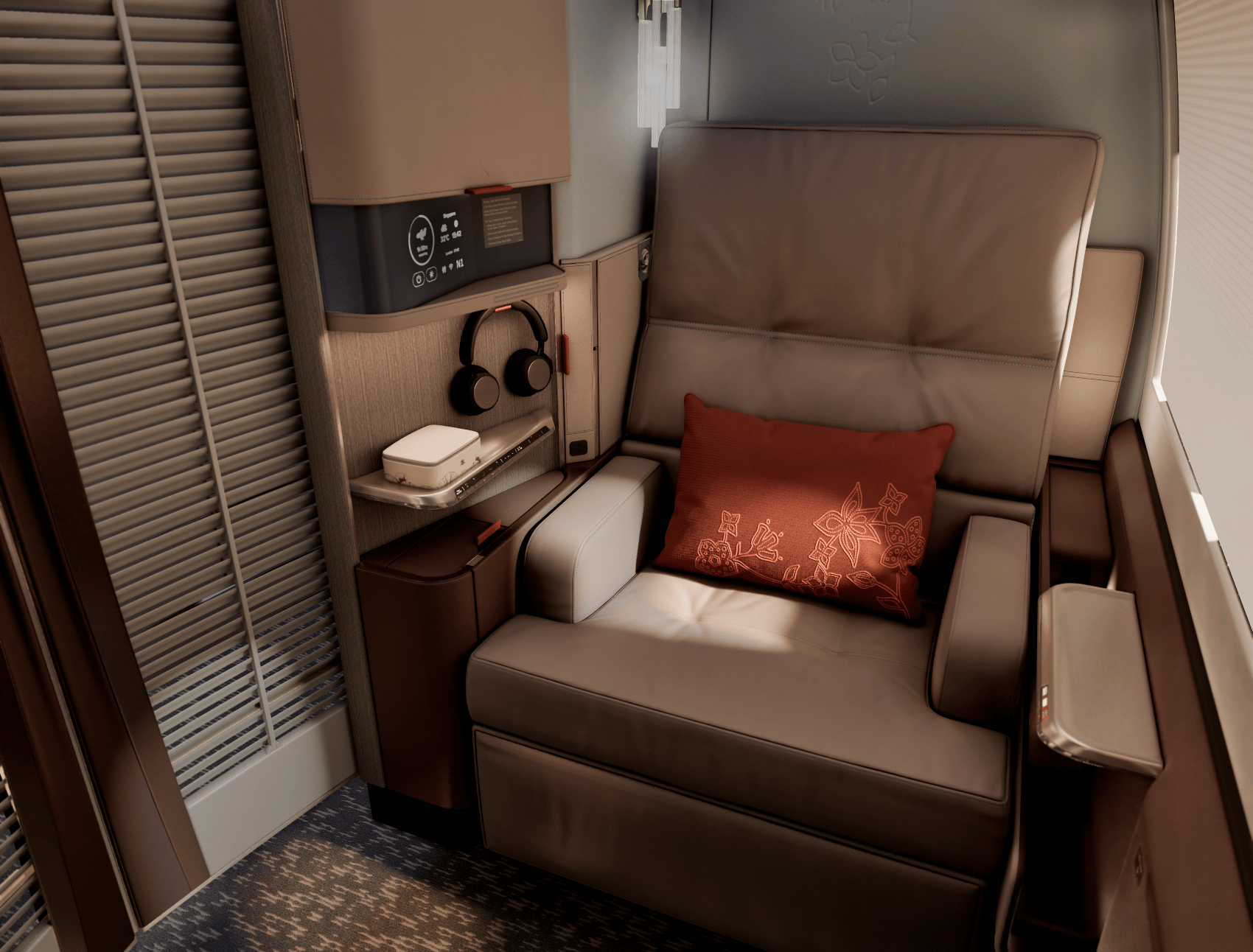
In First Class, the answer is more apparent. Curved doors and a suite-like layout create a sense of enclosure, while louvred details and batik-patterned fabric walls connect the space to Singapore Airlines’ visual heritage. On the 777-9, there will be six suites; the A350-900ULR will have four. The centre seats can become a shared sofa or, with the divider retracted, an 80-inch double bed measuring five feet across. It is an ambitious arrangement, but the technology is softened by a sense of occasion and place.

Business Class feels less settled. Its grey forms, tall partitions and yellow accents make a confident visual statement, but one that could belong to almost any airline pursuing a contemporary premium cabin. The yellow brings energy, and the seat looks capable. Yet the combination creates a harder, more synthetic mood than the one Singapore Airlines has spent decades cultivating. At times, the automotive finish seems to speak louder than the airline’s own design language.

There is a practical trade-off here, too. Singapore Airlines’ current long-haul Business Class seat is unusually broad, with a published width of 28 inches. The new seat is listed at 22 inches on the A350 and 24 inches on the 777-9, while the new lie-flat bed is up to 24 inches wide.


These measurements may not be perfectly like-for-like, given the different shapes and mechanisms of the seats, but the figures point to a change in emphasis: less generous sprawling space, more enclosure, privacy and structure. The airline is exchanging one distinctive quality for another.

That exchange matters because privacy doors are no longer a unique selling point. ANA introduced its door-equipped THE Room in 2019, developed with architect Kengo Kuma and British design studio Acumen. ANA described it as inspired by multifunctional Japanese living spaces, with wood finishes and a wide, sofa-like seat. Japan Airlines’ A350-1000, unveiled in 2023, also places every Business Class passenger in a private suite. JAL framed its cabin around Japanese aesthetics and tranquillity. Both products make a case for modernity, but their references give that modernity a point of view.
Singapore Airlines has the materials for its own. The batik motif, the Singapore Girl’s sarong kebaya and the midnight blue and gold of its livery are unusually durable brand assets in an industry where cabin palettes often blur together. They work best when treated as a starting point for design, rather than a motif to add after the larger decisions have been made.

First Class comes closer to that balance. The batik wall panels are part of the suite’s texture and atmosphere, rather than an isolated logo or flourish. Business Class, by comparison, places more faith in contemporary materials and form. Its visual language is coherent, but coherence does not make a cabin distinctive. There is a difference between looking modern and expressing a particular airline’s idea of modernity.

The contrast becomes more striking alongside Singapore Airlines’ refreshed SilverKris lounges. The 2022 flagship redesign at Changi was a S$50 million project spanning 6,100 square metres and designed to accommodate around 1,150 guests. Its language combines contemporary finishes with batik references, warm seating, art and crafted lighting. The new First Class suite seems to continue that conversation. Business Class feels as if it has stepped into another one, with a cooler, harder and more overtly technological vocabulary.
Modernity is not a territory Singapore Airlines can own simply by making its cabins feel futuristic. Around the region, JAL and ANA have shown that contemporary design can still express a clear cultural identity. The door, the screen and the private suite are now part of a shared premium vocabulary. As more airlines adopt them, the details that give those spaces character matter more.

Singapore itself offers a richer design brief than the familiar shorthand of glass towers and illuminated skylines. The city’s identity also lives in its tropical greenery, shophouses, neighbourhoods and layers of culture, food and craft. Those references need not be used literally or nostalgically. They can shape choices of colour, pattern, material, light and hospitality, giving a cabin a sense of place without turning it into a heritage display.
That has long been one of Singapore Airlines’ strengths. Its appeal has never been only a polished cabin or an efficient journey. It has also carried a romance of travel: the feeling that a flight could have its own rituals, atmosphere and sense of possibility. The batik motif and the crew uniform have endured because they mean more than decoration. They connect the service to a place and to a particular idea of welcome.
The airline says research involving more than 5,000 travellers, employees and industry experts informed the new products, with privacy, comfort, flexibility and intuitive features among the priorities. The new seats respond directly to those expectations. But designing around customer needs and building a distinctive brand are not competing tasks. A better recline, a larger footwell and a sliding door can all sit within a visual language that feels unmistakably Singaporean.


The new Business Class seat appears to have solved many of the practical problems it set out to address. What remains less clear is what Singapore Airlines wants modernity to feel like. First Class offers one answer, balancing contemporary privacy with recognisable references to the airline’s heritage. Business Class has not quite found the same balance.

Perhaps this is not the end of the golden era of travel, but a moment when its old codes are being tested. The next generation of cabins may be quieter, more private and more technologically capable. They still need to feel as if they belong somewhere. Singapore Airlines has spent years showing that refinement lives in the details. Its new seats are full of them. The opportunity now is to make those details tell a story that could only be its own.
As I do every year, I ask on your kind support to keep things going. If you are able to donate – whatever amount – it all gets funnelled back in to the site, to keep the site full of content. And I thank you personally for your kind support.
Discover more from TheDesignAir
Subscribe to get the latest posts sent to your email.
